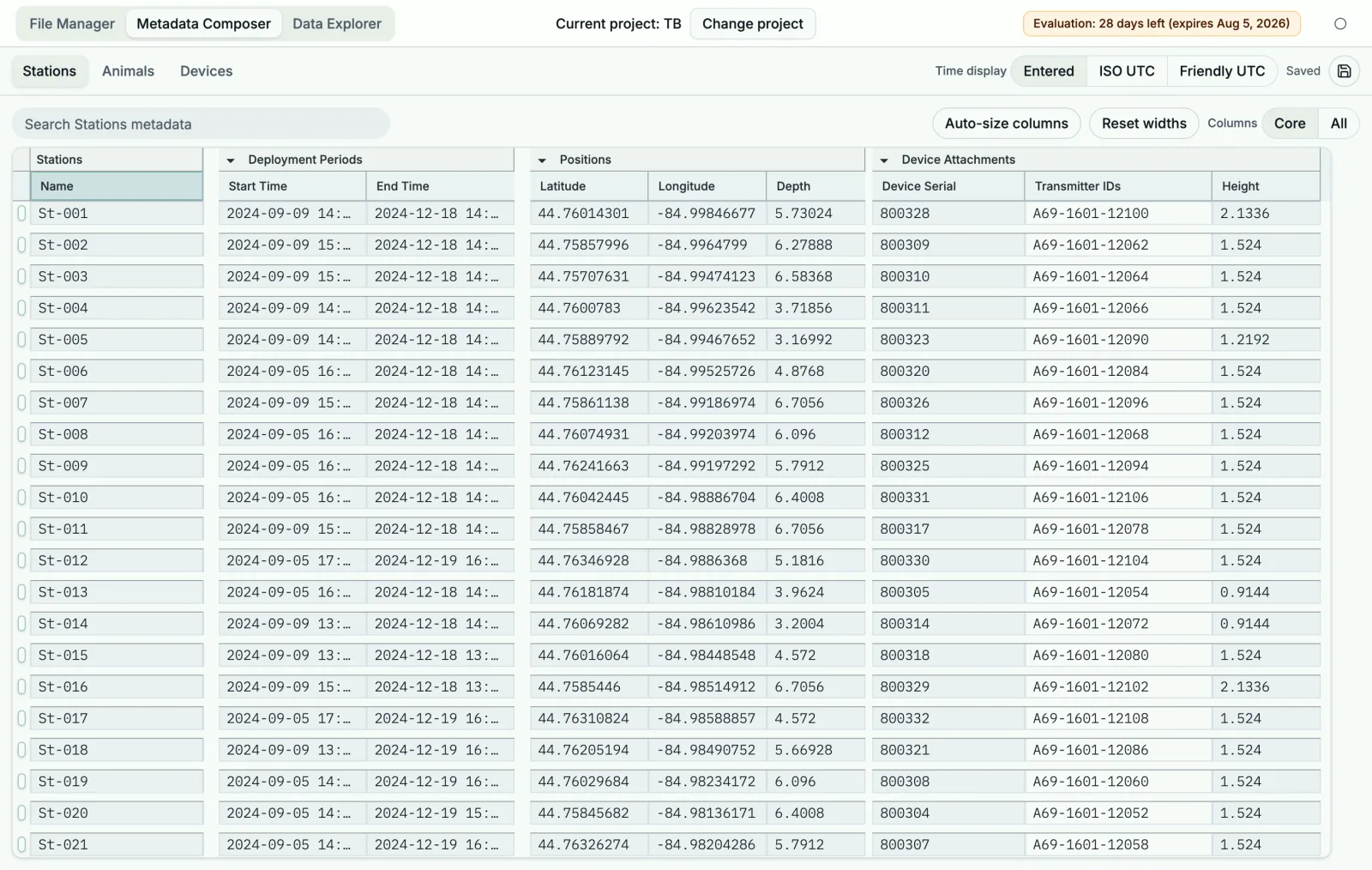
Metadata Composer
Stations, deployments, locations, and devices remain connected, with feedback beside entries whose relationships or details need review.
I build custom software for acoustic telemetry and other data‑intensive work.
Years spent constructing and analyzing acoustic telemetry datasets have shown me firsthand how difficult and time-consuming this work can be. It does not have to be this way.
A foundation to build on
I built the ReceiverLogs App from that experience. It is a high-performance desktop software product that brings receiver-log data and study metadata together in one project.
That makes it the ideal foundation for study- or team-specific functionality—without starting from scratch.
Explore the ReceiverLogs App (opens in a new tab)Stations, deployments, locations, and devices remain connected, with feedback beside entries whose relationships or details need review.
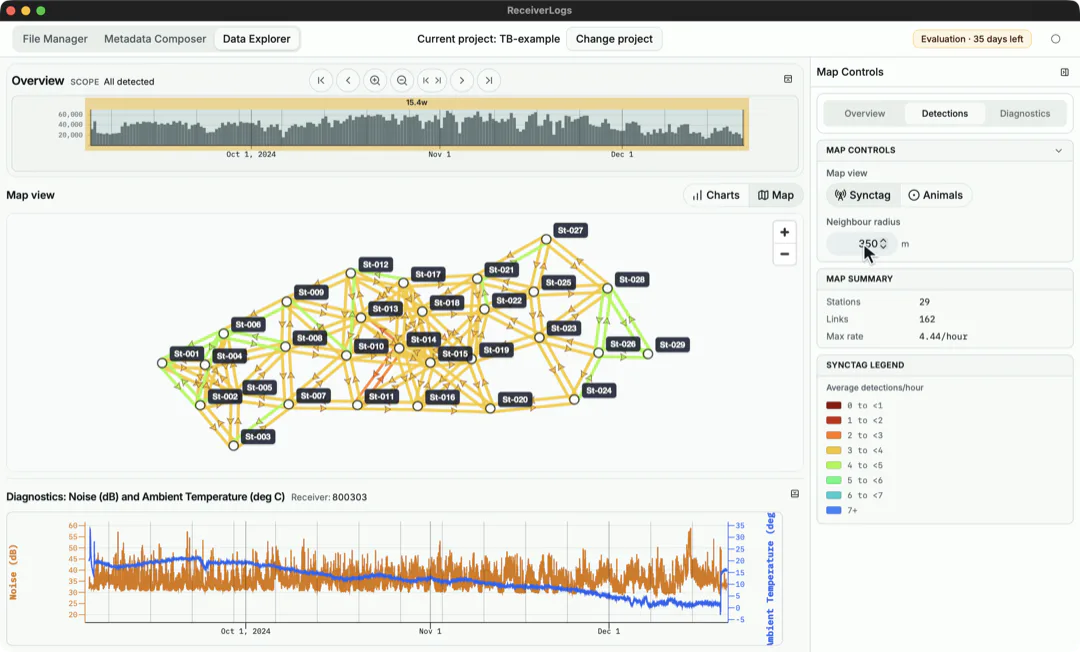
For the selected time period, maps, charts, checks, and summaries stay coordinated so detection activity and receiver performance can be reviewed together.
I build focused tools for recurring acoustic telemetry work that teams would otherwise piece together and repeat by hand. They help teams apply established methods consistently while keeping exceptions and decisions visible for review, rather than replacing scientific judgment.
I extend the ReceiverLogs App when its foundation fits the work, and develop separate software when it does not.
The examples below describe possible custom work, not features currently available in the ReceiverLogs App.
I work directly with you to define what the software must do and review working versions against real data and domain requirements. I remain accountable for quality; AI assists with planning, development, testing, and documentation.
Production setup, deployment, hosting, maintenance, and ongoing support are scoped separately.
See a documentation example: ReceiverLogs App Help (opens in a new tab)Whether your project involves acoustic telemetry or other data-intensive work, you do not need a finished specification. Tell me what you need to accomplish, what your team has to piece together or work around, and what a useful result looks like. I work directly with you; a few sentences are enough to begin.
If the immediate need is a coherent, documented dataset, start with Dataset Construction. If the method itself still needs to be worked out or tested, start with Method Development.