Publications

My publications as an Acoustic Telemetry Data Specialist examine how underwater acoustic signal timing can support animal-position estimates, how to characterize their uncertainty, and how machine learning can assist fish detection and acoustic-tag identification.

Acoustic telemetry and positioning

These papers follow fine-scale acoustic positioning from system design through field validation and error interpretation. Together, they show what receiver arrays can resolve and why positioning performance should be evaluated before VPS-derived spatial data are interpreted.

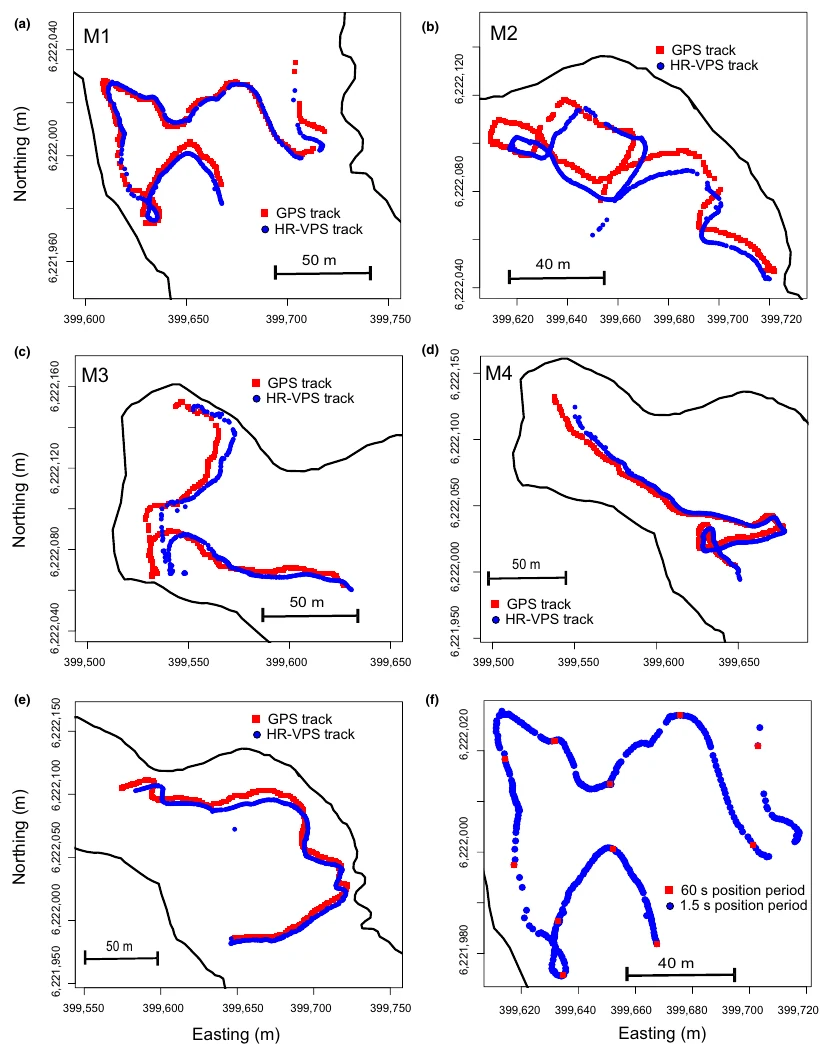
Five moving trials comparing GPS tracks with HR-VPS estimates, plus one track comparing native 1.5-second positions with positions thinned to 60-second intervals.
Five moving trials compare HR-VPS tracks with GPS; panel f shows path detail lost when positions are thinned from 1.5-second to 60-second intervals.

Figure 3, Guzzo et al. (2018), CC BY 4.0 (opens in a new tab). Cropped for layout.
Field testing a novel high residence positioning system for monitoring the fine-scale movements of aquatic organisms

The first documented HR-VPS field test used stationary and boat-based trials, then illustrated fine-scale movement with five tagged European perch. Median stationary accuracy relative to handheld GPS was 5.6 m; moving tracks differed from GPS by about 9 m. Thinning perch data from a mean 4-second interval to 60 seconds removed 93% of positions and reduced estimated speed and distance travelled.

View paper (opens in a new tab)
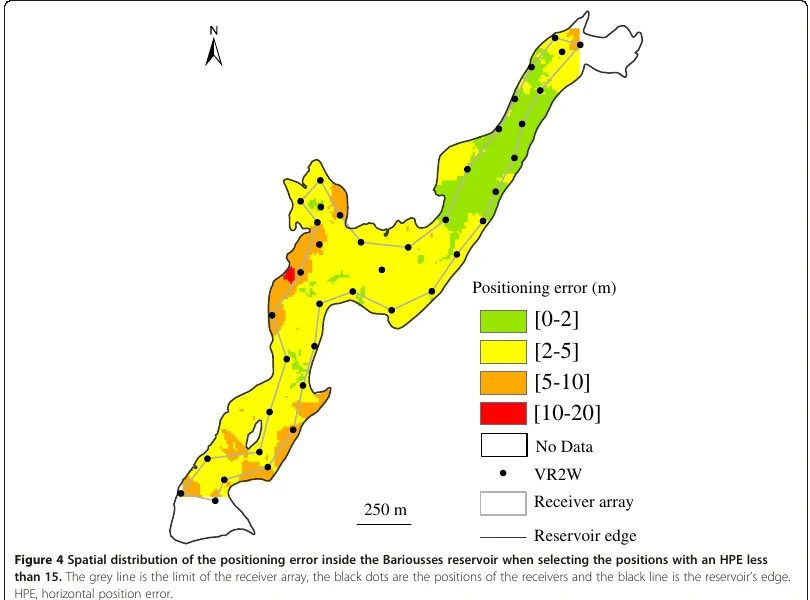
Map of the Bariousses reservoir showing positioning-error bands after filtering to HPE below 15, receiver locations, and the receiver-array boundary.
After filtering at HPE below 15, error was under 5 m across most of the reservoir and lowest where receiver density was highest.

Figure 4, Roy et al. (2014), CC BY 2.0 (opens in a new tab). Cropped for layout.
Testing the VEMCO Positioning System: spatial distribution of the probability of location and the positioning error in a reservoir

A 40-receiver study mapped probability of obtaining a position and positioning error across a hydropower reservoir before ecological analysis. Filtering at HPE below 15 retained 79% of positions and reduced mean error by 33%, to 3.3 m. Both measures varied spatially, so performance should be evaluated and mapped before VPS-derived spatial data are interpreted.

Read the open-access paper (opens in a new tab)
Additional papers

Selected work presented without publication figures.

Using underwater coded acoustic telemetry for fine scale positioning of aquatic animals

This proceedings paper describes VPS as an autonomous TDOA system using three or more receivers and stationary synchronization transmitters (“synctags”) to estimate receiver clock skew. It reports studies from 2,500 m² to more than 15 km² and unattended operation for months to a year or more. Positions are calculated after receiver recovery; reported temporal resolution is on the order of minutes and typical spatial resolution is 5–15 m, with accuracy varying by study and over time.

View proceedings paper (opens in a new tab)

Understanding HPE in the VEMCO Positioning System (VPS)

This technical paper explains what Horizontal Position Error (HPE) does—and does not—mean. HPE is a relative, unitless measure of error sensitivity—not a calibrated estimate of the error of an individual position in metres, and not comparable among studies. Calculated positions from known-location synctags and reference transmitters allow the relationship between HPE and measured error or precision to be characterized statistically for each VPS dataset.

View paper on ResearchGate (opens in a new tab)

Testing a new acoustic telemetry technique to quantify long-term, fine-scale movements of aquatic animals

This field validation used 16 receivers and eight fixed synchronization transmitters with stationary, slow-moving, and free-swimming transmitters. Mean stationary positional error was 2.64 m (SD 2.32 m) and significantly lower inside the array. VPS and active tracking produced statistically similar home-range and movement estimates; receiver and synchronization-transmitter number, layout, and proximity materially affected performance.

View paper (opens in a new tab)

Machine learning for aquatic monitoring

These projects apply deep learning to two labour-intensive problems: observing untagged fish—detecting and classifying them in imaging sonar, and tracking and counting them in optical video—and identifying period-encoded acoustic tags amid noise and interference.

Additional papers

Selected work presented without publication figures.

Applying deep learning to imaging sonar for the automated detection, classification and counting of untagged fish in fish passages

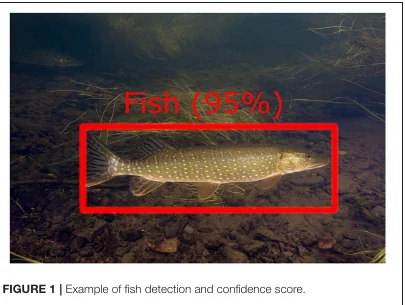
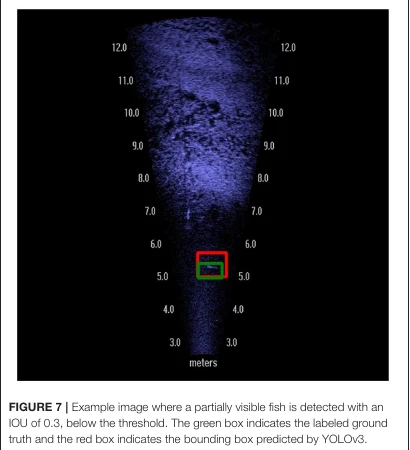
A 2021 meeting abstract reporting adapted YOLO models that detected and classified eight fish species in the public Ocqueoc River DIDSON dataset. The authors described it, to their knowledge, as the first successful deep-learning classification of multiple fish species with high-resolution imaging sonar; it formed part of real-time fish-passage-system development.

View abstract (opens in a new tab)

The use of deep learning techniques in acoustic tag signal identification

HTI period-encoded signals use full transmitted energy for detection and identification, offering greater range than encoded BPSK signals; identifying them then typically required trained manual review. This work transforms telemetry into a spectrogram-like image and trains U-Net to separate tag detections from noise and interference, reporting greater than 95% identification accuracy against human analysis of the same test data.

View abstract (opens in a new tab)

Identification of periodic fish tags with deep learning

The study converts ping-time data into images, applies U-Net segmentation and inverse pixel-to-ping filtering, and tests tags excluded from training. Across six test sets, it reports 96.6% (±1.9%) for U-Net versus 41% (±10%) for MarkTags, describing the F1-based values as accuracy. Supplying the tag period and detecting faint tracks remained important limitations.

View paper on ResearchGate (opens in a new tab)
Need Dataset Construction, Method Development, or Software Development? Discuss your work